Ideas & guides · Adult groups · Winter
Winter Activities for Seniors: 6 Seated Ideas for Adult Groups
 By Gather & Print
A winter gathering can be a few people around a table, a short word game and a conversation that takes its own direction. These six seated activities offer starting points for seniors and adult groups without requiring a trip outdoors, a performance or a fast answer.
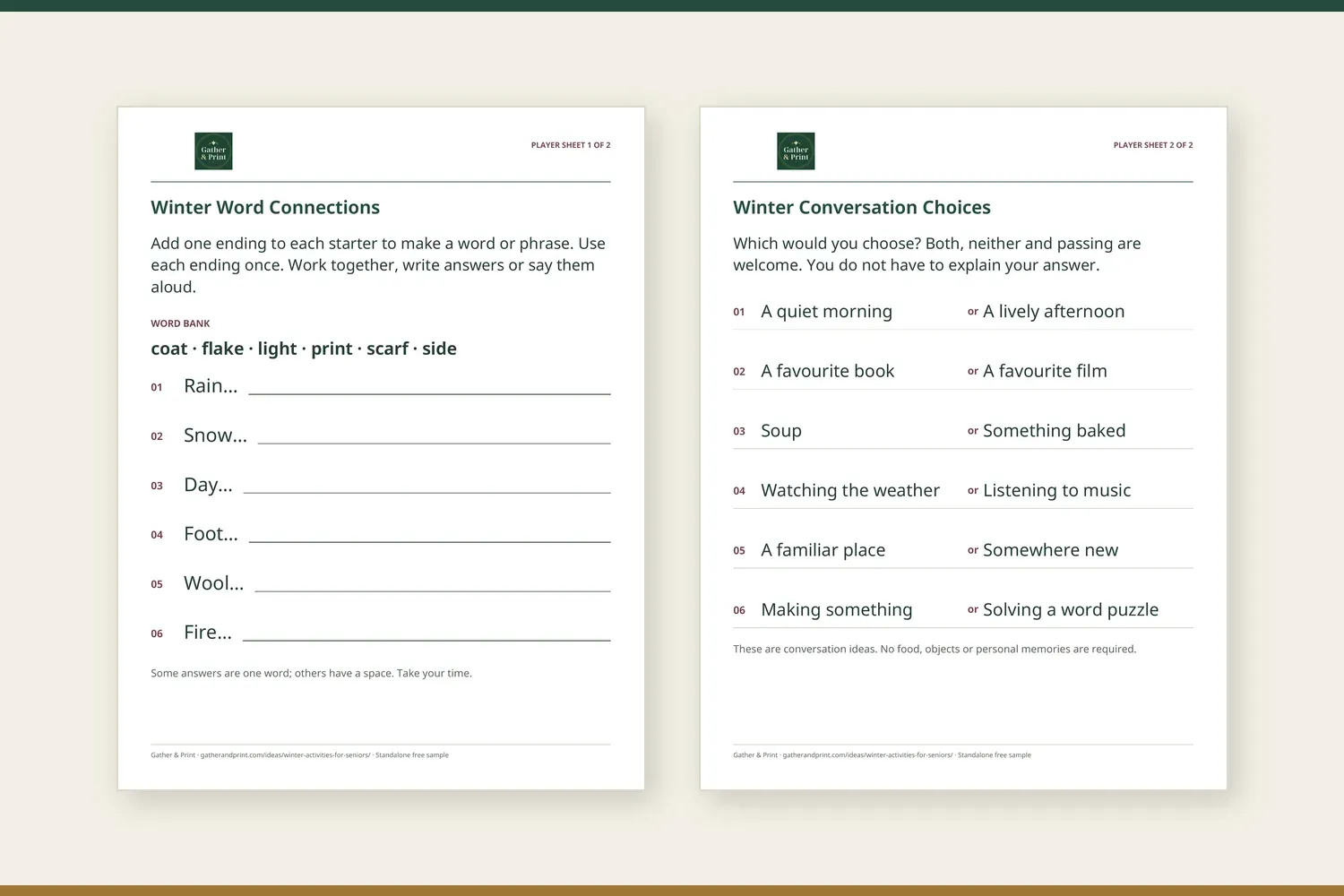
Choose the activities your group wants to try. You can use all the examples on this page, or download the free winter sample for a word-connections sheet, conversation choices and a separate host page.
Start with a short plan
For a small gathering, try this 30-minute session. Treat the times as a guide rather than a target everyone has to keep up with.
| Part | Suggested time | What to do |
|---|---|---|
| Welcome and choice | 5 minutes | Explain the activities and ask what people would like to try |
| Winter word connections | 10 minutes | Solve together, individually or with a partner |
| Conversation choices | 10 minutes | Read a few pairs and invite optional answers |
| Finish together | 5 minutes | Share a favourite word or choose an idea for another visit |
For these examples, a small group of two to eight people plus someone to read and guide the session is a suggested starting arrangement, not a tested capacity or a limit on the paid kits. For a larger gathering, use small tables or pairs and allow more time to hear people.
What to prepare
- Paper and pencils, if people want to write.
- One word sheet per person or pair, or one copy for the host to read aloud.
- Conversation choices for the host or each table.
- A comfortable place to sit and enough light to read the pages.
Ask what would make participation easier: larger text, a spoken prompt, a partner or more time. Let people choose to answer, listen or pass. Sitting out a round does not need an explanation.
You do not need to cut cards, bring food, use a screen or move around the room for this sample. Winter can mean different things in different places, so change a seasonal example if it does not fit your group's experience.
1. Winter word connections
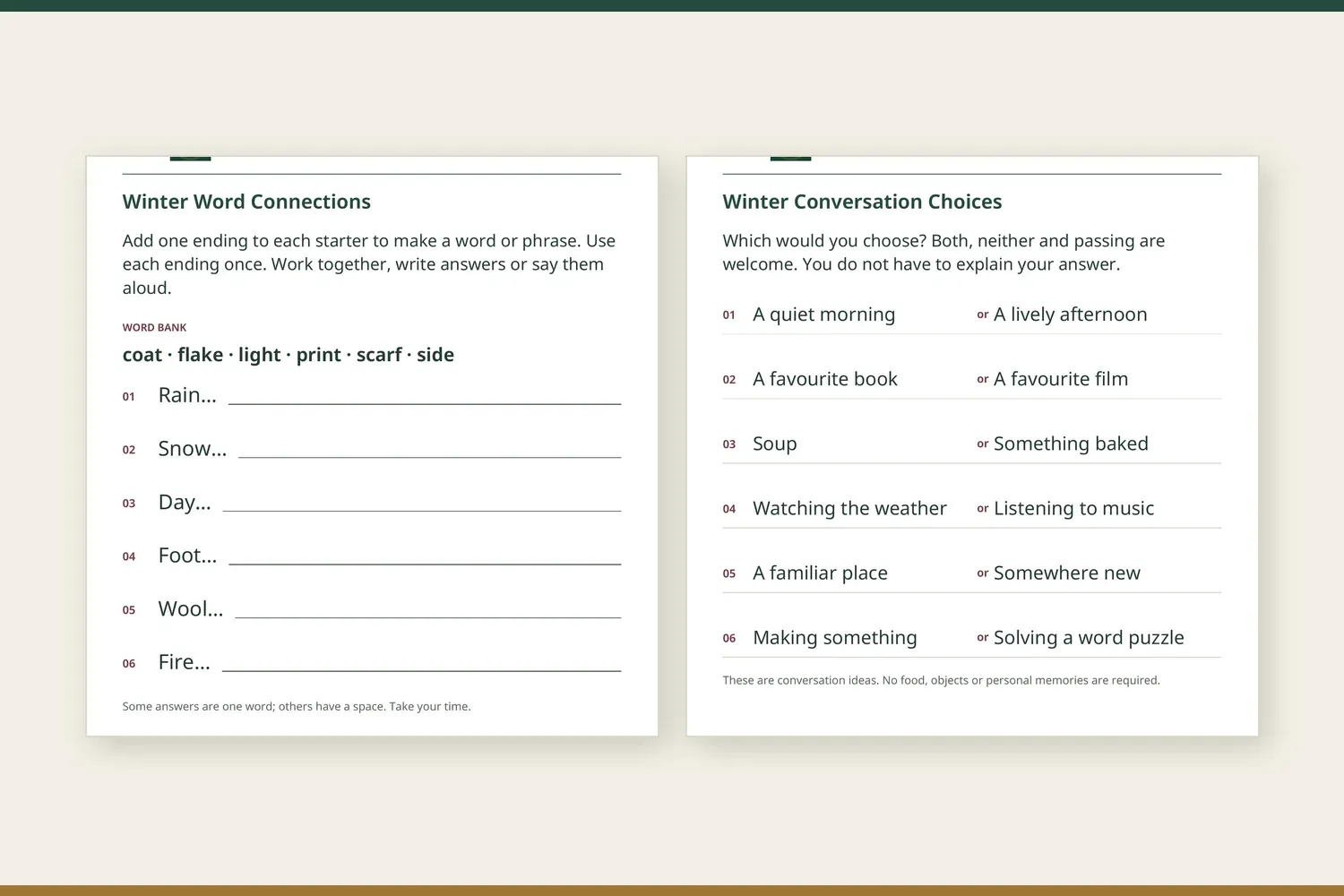
Add an ending to a starter to make a familiar word or phrase. Some join into one word; others keep a space. Work together or write answers on the free sheet. Use each ending once for the intended solution.
Endings: coat, flake, light, print, scarf, side.
| Starter | One intended answer |
|---|---|
| Rain… | Raincoat |
| Snow… | Snowflake |
| Day… | Daylight |
| Foot… | Footprint |
| Wool… | Wool scarf |
| Fire… | Fireside |
Read the word bank aloud if helpful. The host sheet also has a short hint for each answer. Accept another familiar word or phrase if someone explains it, even if you then help the group find the intended matching solution.
Keep it untimed. You can solve one example together first, and nobody needs to finish a sheet to take part.
2. Conversation choices
Offer two possibilities and invite a preference. There are no right answers. “Both,” “neither” and “it depends” are welcome, and nobody has to explain their choice.
Try these six pairs:
- A quiet morning or a lively afternoon?
- A favourite book or a favourite film?
- Soup or something baked?
- Watching the weather or listening to music?
- A familiar place or somewhere new?
- Making something or solving a word puzzle?
Read one pair at a time and follow the conversation if people want to talk. These are preferences, rather than a test of memory or an invitation to share private experiences. The food pair is just a conversation prompt; no food or tasting is required.
3. Mystery objects
Read a short clue and ask what ordinary object it might describe. Offer two choices if the group would like a little more support:
- “I have pages and a cover, and you can read me.” A book or a mitten? Intended answer: a book.
- “I am a long strip of fabric you can wrap around your neck.” A scarf or a calendar? Intended answer: a scarf.
- “I can stand on a table and light the page beside you.” A lamp or a basket? Intended answer: a lamp.
Accept a sensible alternative where the clue allows it. You can also invite people to invent a clue together for a familiar object. There is no need to keep scores or award a winner.
4. A shared category round
Choose one category and collect ideas aloud. Write them down only if the group wants a shared list. Start with one of these:
- Things that can make a room feel comfortable: a chair, cushion or lamp.
- Things you might find near a front door: a mat, shoes or umbrella.
- Things people can do indoors on a winter afternoon: read, sketch or listen to music.
- Things that make a sound: a bell, clock or radio.
These are examples rather than a fixed answer key. There is no requirement to take turns in order or produce a unique answer. Someone who prefers to listen can choose which category comes next.
5. Describe something nearby
Choose an ordinary object already within view, such as a mug, notebook or vase. The host can hold or describe it if that helps. Invite one observation at a time: its colour, shape, material or what someone might use it for.
For example: “The notebook is blue,” “It has a spiral edge,” or “It could hold a shopping list.” You do not need to pass objects around or ask anyone to stand up and search the room.
If the object is hard to see, describe it aloud or move to a different activity. Keep this an exchange of observations, not a test of who notices most.
6. Plan a cosy hour together
Offer three imaginary activities: a short story, a music choice and a word game. Ask the group which order they would prefer and what they would leave out if time were short.
There can be several good plans. Someone might want the word game first, while another would rather begin with music. Invite reasons without asking the group to find a single correct solution.
You can use the choices to shape the next actual gathering. Only promise activities, materials or assistance that the organiser can provide.
Free standalone sample
Free winter word-game and conversation sheets
Choose the paper size that matches your printer:
Each PDF has three pages: the six-item word-connections sheet, six conversation-choice pairs, and a host sheet with answers, optional hints and the 30-minute plan. Both paper sizes contain the same activities. No email address or purchase is required.
Print only the pages you want to use. One host copy can be enough for a spoken round; give individual or paired copies to people who want to read or write. Choose the file matching your paper size and check print preview.
The sample is a standalone free activity, rather than an excerpt from a paid kit. Familiar words or activity types may also appear in other collections. It does not include bingo or a factual trivia round.
Want a prepared set for more visits?
For a seasonal collection, preview the Cozy Winter Social Hour Host Kit. Check its current activity list, reading support, formats, host instructions and preparation requirements.
For a year-round option, explore the Everyday Social Hour Host Kit. Its product page explains the current word games, other activities and session choices.
Both are separate paid digital products. Check each listing's current contents and use permission before choosing a kit for a household or organised group.
Common questions
What winter activities can a group do while seated?
Try a shared word game, preference questions, object clues, a category list, observations about a nearby object or a simple planning conversation. Choose a few rather than trying to fit all six into one session.
Do participants have to write answers?
No. The host can read aloud and people can answer verbally, work with a partner or listen. The free word sheet is optional support, rather than a requirement to complete a worksheet.
Are these competitive games?
The examples on this page are unscored. You can work towards a shared answer or enjoy different preferences without choosing a winner.
Are the activities suitable for everyone?
People have different interests, reading preferences and support needs. Choose with the people attending and adapt the session accordingly. These recreational examples have not been assessed as suitable for a particular diagnosis or care programme.
About Gather & Print
Printable games and activity guides for family gatherings, workplace events and adult groups. Explore the free samples, preview the products and contact us if you need help with a download.